About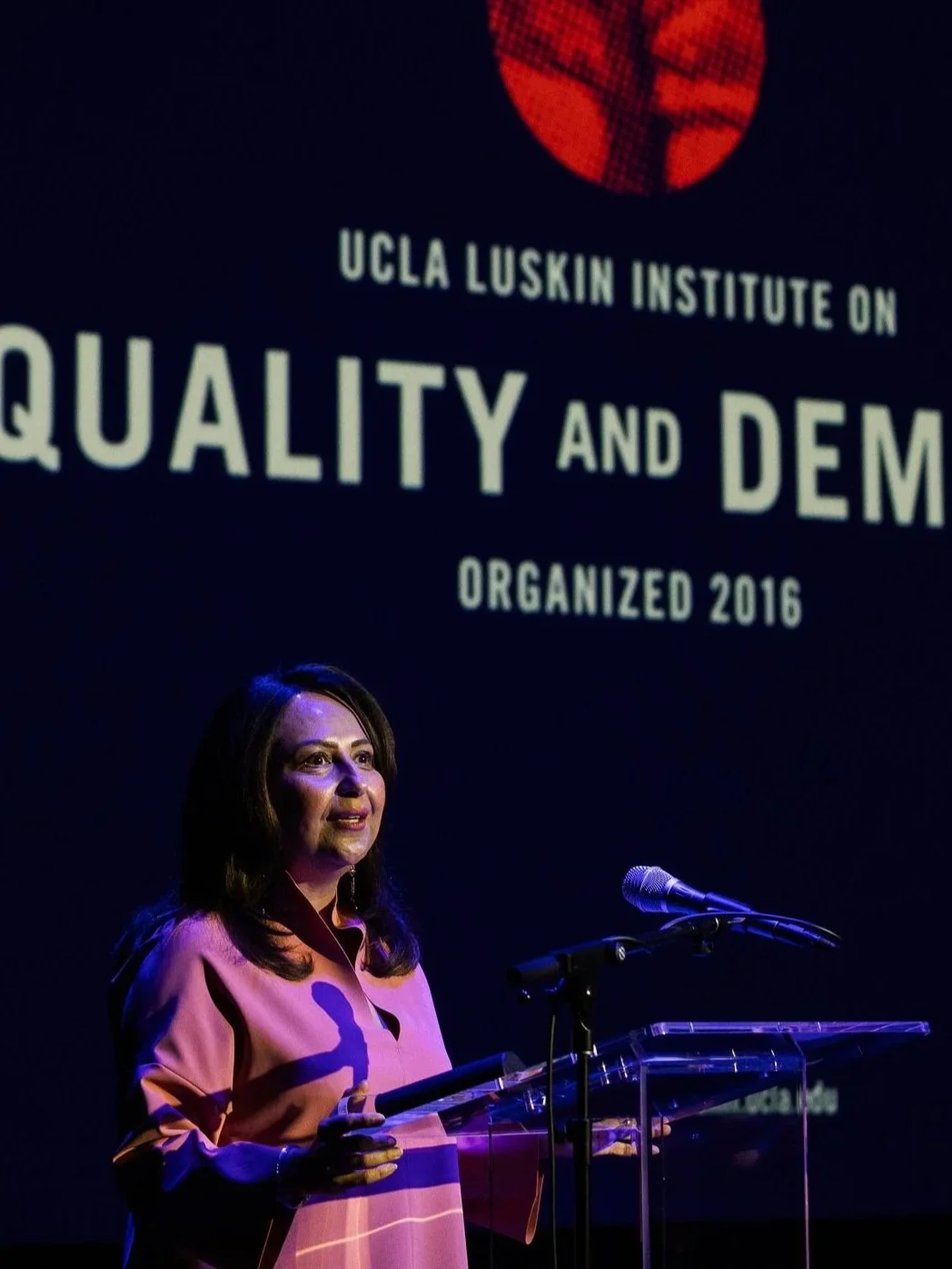
Thinking from the South, Divesting from Whiteness, Refusing Patriarchy
Ananya Roy is Professor of Urban Planning, Social Welfare, and Geography at the University of California, Los Angeles. From 2015 to 2026 she served as the founding director of the UCLA Luskin Institute on Inequality and Democracy and held the Meyer and Renee Luskin Chair in Inequality and Democracy. During her leadership tenure, the Institute undertook research and scholarship to advance social justice, accompanying movements and communities on the frontlines of dispossession and displacement. In doing so, it sought to transform the public university, notably the relationship between universities and movements for freedom and liberation.
Previously Ananya was on the faculty at the University of California, Berkeley, where she held the Friesen Chair in Urban Studies from 2009 to 2011 and the Endowed Chair in Global Poverty and Practice from 2007 to 2015. She is the recipient of the 2006 Distinguished Teaching Award, the highest teaching recognition that the University of California, Berkeley bestows on its faculty. Also that year she received the Distinguished Mentorship Award, the highest mentorship recognition that the Graduate Assembly of the University of California, Berkeley. In 2008, Ananya received the Golden Apple Award, the only teaching award given by students at UC Berkeley. In 2011, Ananya received the Excellence in Achievement award of the Cal Alumni Association, a lifetime achievement award which recognized her contributions to the University of California and public sphere.
Ananya was editor of the International Journal of Urban and Regional Research from 2016 to 2020. She is a 2020 Freedom Scholar, an award bestowed by the Marguerite Casey Foundation and Group Health Foundation to scholars who advance social and racial justice. In 2022, Ananya was awarded an honorary doctorate by the University of Geneva.
Ananya is a scholar of global racial capitalism and postcolonial development whose research is concerned with the political economy and politics of dispossession and displacement. She holds a B.A. in Urban Studies from Mills College, and a M.C.P. and a PhD. in Urban Planning from UC Berkeley. In 2022, she was recognized with an honorary doctorate by the University of Geneva. With theoretical commitments to postcolonial studies, Black geographies, and feminist theory, she seeks to shift conceptual frameworks and methodologies in urban studies to take account of the colonial-racial logics that structure space and place. Her books, articles, and public scholarship have focused on urban transformations and land grabs, global circuits of financialization, and postcolonial development and projects of poverty management. Ananya’s current research and scholarship focuses on two key themes: sanctuary spaces and housing justice.
At a time of resurgent white nationalism, Ananya has undertaken inquiry into the promise and problem of sanctuary. In 2020-2021, she led a Mellon Foundation Sawyer Seminar on Sanctuary Spaces, which critically examined the place of racial others in the liberal democracies of the West. Together with Veronika Zablotsky, she is editor of Beyond Sanctuary: The Humanism of a World in Motion, which brings together scholars from the United States and Europe to study the colonial-racial logics of asylum and humanitarianism and the migrant movements that demand a world beyond borders.
Housing justice has been at the center of Ananya’s work for many years now. From 2018 to 2013, she led a National Science Foundation Research Coordination Network on Housing Justice in Unequal Cities, which created a global field of inquiry shared by university and movement scholars. Together with Robin D.G. Kelley, Ananya currently leads Housing the Third Reconstruction, a project supported by the Mellon Foundation’s Higher Learning initiative. Her ongoing scholarship, organized in the form of insurgent research collectives, is concerned with the liberal governance of mass homelessness and centers poor people’s histories. Ananya is currently working on a monograph on racial banishment, the expulsion and social death of working-class communities of color through racialized policing and other forms of dispossession. In comradeship with unhoused communities in Los Angeles, she studies counter-geographies of refusal and rebellion. Ananya strives to advance research justice, by which she means accountability to communities directly impacted by state-organized violence. At the very heart of her work is an insistence on the transformation of the public university – through teaching, public scholarship, and community engagement – so that it can be a force for social justice.